April reads

Apparently April is the month where I catch up on horror. It’s such a weird genre for me. I am fascinated by horror but also easily annoyed by it. I dislike people being cruel to each other for no reason. I dislike people suffering for no reason. And I really dislike nihilistic downer endings. It’s one of the things that turned me off of Supernatural—Sam and Dean had made everywhere hostile to them, so much so that even death wouldn’t be a rest (Yes, I know the series resolved well. I just gave up for a long time around season 10.)

But I also love people struggling against forces that they don’t understand. I love people trying to survive long odds—not undamaged, but coming out alive. I love man vs. monsters. I also really love the style. A lot of horror writing is extremely visceral (no pun intended) and powerful. It’s a genre of senses. The creeping cold around your ankles, that scratching of claws against your window, the scent of something subtly wrong, and on and on and on. Love that. It’s probably the most sense-driven genre.

So this month I read:
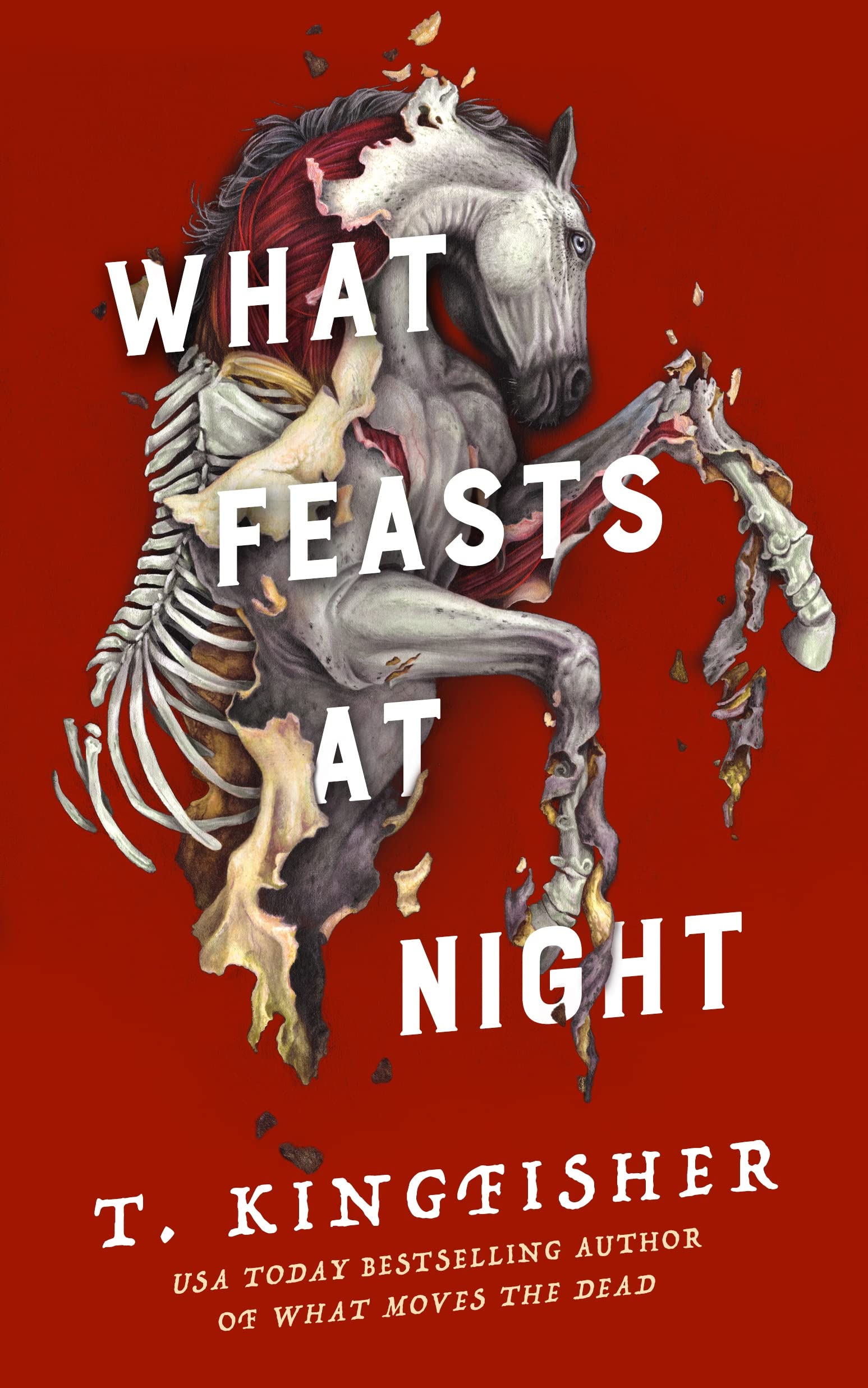
What Feasts at Night – T. Kingfisher

In this novella, a soldier decides to take a sojourn at their cabin in the woods, mostly to facilitate their batman’s affair with a mycologist. Of course, nothing is ever that easy. Easton arrives to find the caretaker dead and something lurking in the woods. I really adored What Moves the Dead, the first novella in this (hopefully long-running) Sworn Soldier series. I adored it, even though it used the Fall of the House of Usher as its springboard. I have contradictory opinions about books based on other fiction—suffice it to say that I approach all books of that ilk with suspicion.

What Feasts at Night was not quite as good as the first novella but was still an excellent read and a keeper. Kingfisher is really wonderful with setting and characterization. I always feel like I am immersed in her world, and I would love to hang out with her characters. I’m adding this series to my shelf with Sarah Monette’s Grave Key.
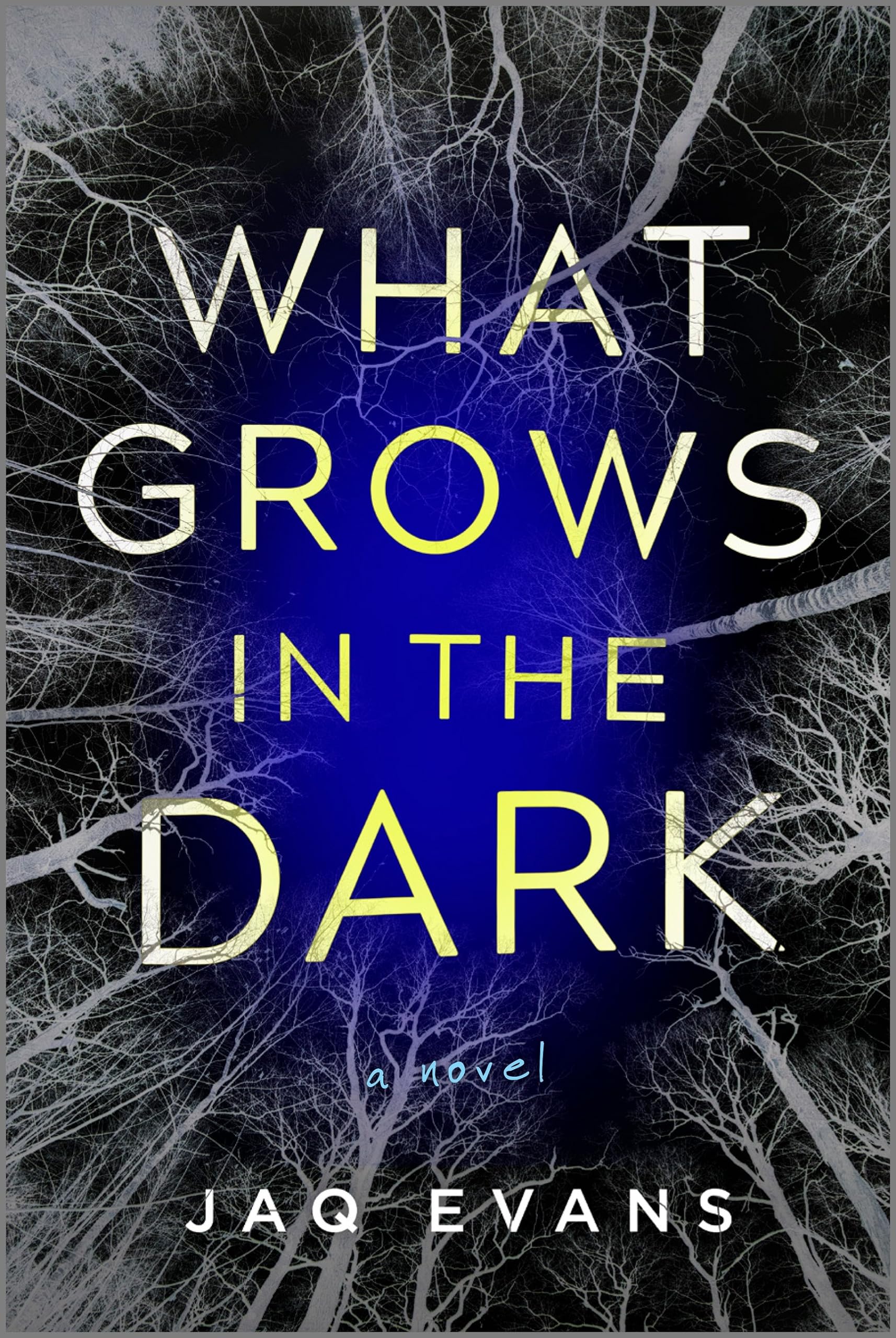
What Grows in the Dark – Jaq Evans

This is a tricky book. It has a heroine who is not particularly likeable, being repressed, and a con artist of sorts. She claims to be a psychic so that she and Ian, a college friend (who doesn’t really know her that well) can travel around making a little bit of money making youtube videos. She gets called back to her small town by her dead sister’s girlfriend who says something is taking other kids. The way it took her sister. Usually, I dislike characters who aren’t forthcoming with their friends and allow situations to go from bad to worse, but here, it works. This book never really gets terrifying, but it is definitely slow burn creepy.

A Cosmology of Monsters – Shaun Hamill

Strange, strange book. I loved it. It’s a literary sort of horror, about a family over decades, primarily the youngest son. And of course, it’s about the monsters that are haunting them. I really liked the monsters and their relationship to humans.

Where He Can’t Find You – Darcy Coates

A YA horror novel.

This one might be my favorite read of the month, not just of the horror books I read. I adored this book from page 1 to the end. It’s got a fairly standard premise: there’s a killer in a small town, and if you’re not careful, it’ll get you! But what really made this stand out is that everyone knows what’s up from page 1. The Stitcher is the town bogeyman; the teens think they know who he is, and the police agree, but! There’s no evidence. There’s none of that slow “we must convince people we’re right!” They start off believing two things at once: that the creepy man who smiles is the Stitcher, and that the Stitcher’s kills come on a crest of inexplicable events—technology failing, animals being born deformed, etc. I’m not a huge Darcy Coates fan; her books are hit or miss for me, but this one is a definite hit.

The Grip of It – Jac Jemc

This piece is as hard to follow in some ways as a fever dream, and that’s really what this book is like. Nightmarish. But you’re in it, and you’re accepting it, and then you wake up. The premise is a straight-forward as these stories go: a married couple with some problems buy a haunted house. Things get worse. This is definitely a book where the style is what sells it. If you want your hauntings wrapped up with a bow, though, this is not the book for you.

I also watched The Dead Boy Detectives, which I mostly liked.

All of these books were good reads.

Book Review: Vigilance by Robert Jackson Bennett

VigilanceRJBVigilance
Robert Jackson Bennett
Tor
190 pages

Why I Chose it:
C’mon.  Robert Jackson Bennett is an autoread for me, and this particular book? As writers, a lot of us struggle with terrible public events, feeling like we should be able to put words on the page to expose the awful truth of things. But most of us just flail in that direction. So when I heard that RJB had written a satirical SF novel about America’s obsession with–and enabling of–mass public shootings, I picked it up.

I wasn’t sure I was going to enjoy it.  Satire is as often bitter as the truths it exposes.

The Premise:
Robert Jackson Bennett’s Vigilance is a dark science fiction action parable from an America that has permanently surrendered to gun violence.

The United States. 2030. John McDean executive produces “Vigilance,” a reality game show designed to make sure American citizens stay alert to foreign and domestic threats. Shooters are introduced into a “game environment,” and the survivors get a cash prize.

The TV audience is not the only one that’s watching though, and McDean soon finds out what it’s like to be on the other side of the camera.

Discussion:
I’m going to avoid spoilers for most of this review, but really there are no surprises here.

The blurb tells us right away that McDean will suffer the same fate as his “contestants”. There are some fiddly little twists, but overall, this book provides what you expect.

And that was… weirdly disappointing.

The book is compulsively readable.  RJB is great at stringing words together and creating vivid characters, even in the shorter form of the novella.

That said, I expected more somehow.  More of an edge. Something more potent than just the USA turning public shootings into a patriotic-tinged game show, which… I’ve seen before and before and before.  So many story-lines go back to the bread and circuses of the Romans–death for sport. It’s not enough to really make me sit back and think. I’ve seen variations on it in Star Trek and Doctor Who and any show that ever declares “fight club to the DEATH!!!”.  It’s trope is what I’m saying. And kind of a tired one to hinge the entire novella on.

(Now if someone wanted to write a satirical novel about the NFL and CTE, that would be interesting, and RJB touches on it a bit here.)

The big problem for me is that I expect a certain level of horror/shock or appalled laughter from my satires—like I did in reading Swift’s A Modest Proposal or Libba Bray’s Beauty Queens.

Or Terry Pratchett’s Jingo, which gave me this:

It was so much easier to blame it on Them. It was bleakly depressing to think that They were Us. If it was Them, then nothing was anyone’s fault. If it was us, what did that make Me? After all, I’m one of Us. I must be. I’ve certainly never thought of myself as one of Them. No one ever thinks of themselves as one of Them. We’re always one of Us. It’s Them that do the bad things.

This is giggle-worthy writing, bleakly true, and best of all, relatable.

In Vigilance, I got that sting only once in the entire book.

McDean’s guts flutter unpleasantly. He does not want to piss off Kruse—but he can’t share the man’s blithe confidence when it comes to subjecting his entire audience to a subliminal AI about which he knows fucking nothing at all. He’s heard Kruse’s people conduct tests on prisoners, and the thought horrifies him: prisoners don’t share the same race and economic backgrounds of any of his primary demographics at all. The population’s all wrong! If that’s his sample, then it’s skewed, utterly fucked! This could decimate his TMAs.
p 69

TMA- Target Market Activations, by the way if you, like me, are not up on marketing terms.

This point stung and resonated, twisted the common expectations of McDean’s horror in an effective way.  We’re poised, after the thought horrifies him, for human rights violations, not poor demographic matches.

McDean is our primary voice, though there is a secondary POV from Delyna, the “Regular girl” who (rightfully) loathes Vigilance. But then, she’s not his target audience at all, being neither white, nor male, nor constantly afraid. She’s feels only tangentially there–much like the comforting commercials McDean airs between scenes of Vigilance–to soothe the reader and keep them turning the pages instead of turning away.

But in the end, Bennett uses Delyna’s POV in a wonderful (horrible) way to make his primary point.

SPOILERS

SPOILERS

SPOILERS

The “Vigilance” TV-watching portion of the USA descends into gun-fueled chaos courtesy of the subliminal AI mentioned above.  Chaos and bloodshed everywhere. Everyone turning on everyone else, guns ablazing like any old Western movie. Not a surprise.  We’ve seen the writing on the wall from page one.

Then there are the customers in Delyna’s bar, and what happens when she dares to turn off the TV in the middle of the episode.

Her patrons don’t fall prey to that subliminal AI because she shut the TV down before the AI started its work; their minds are still their own.   And yet… and yet… they still erupt in violence. Because, as Bennett suggests on every page, once you have a gun in your hand and fear in your heart, there’s no backing down.

So even though Bennett put a third party player on the page, he doesn’t let it absolve the citizens from their murderous, destructive spree.  See, Bennett suggests, they (we) would have erupted eventually anyway.

That’s a powerful statement, and sadly, one that lacks an easy rebuttal.

Overall:
I’m glad I read Vigilance. At the same time, I wish it packed more punch.  Maybe it’s that I keep thinking of Vigilance as a satire, and Bennett wrote it as a parable—a lesson for us to learn from.  Maybe it’s the brevity. There was a lot of world-building glossed over or hand-waved away. Maybe it was just that this was such a White America story and I kept wondering where the other citizens were—just keeping their heads down, like Delyna? Trying to keep a low profile? Or fleeing the country for inexplicable welcomes elsewhere. I felt a lot of absence in this book.

I think, looking at the Jingo quote up above, I know what hampered this book the most for me.  For it to be a satire or even a parable, we have to recognize ourselves in the pages.  We have to say oh god, I’ve thought that, felt that, could I become THAT?!? And I never got that feeling here. McDean is a compelling caricature but he’s not relatable.  I was never in danger of thinking, oh a few missteps and I’d be like him….

There was a tiny moment that zipped by, part of the set-up and explanation for how this game show came to be: ads accidentally get linked to violent footage of a public shooting and… the ad revenue soars because people keep watching and watching.  And watching. That’s relatable.  Our appetite for disasters is marketable.  I believe it. Anyone who reads, watches, or otherwise consumes True Crime stories knows how thin the line is between observing a terrible act and glorifying it.  Between analyzing it and mythologizing it.

I think, in the end, though Vigilance is an enjoyable, thoughtful read, and one I definitely recommend, it isn’t the story I wanted to read. Someone, somewhere has written or is writing something scathing about America’s Gun Problem ™ which holds a mirror up to each and every one of us “regular people”. That’s the one I want to read.